Polyester monofilament
Hengfeng extrudes its own polyester monofilament as the starting material for forming fabrics, dryer fabrics and industrial belts. Controlling the yarn in-house keeps the polymer, diameter, cross-section and heat-setting behaviour consistent with the fabric design. Monofilament can also be supplied for approved manufacturing and repair applications. Because the yarn specification is derived from the end fabric design, we agree the polymer, diameter, cross-section and finish before issuing a written specification.
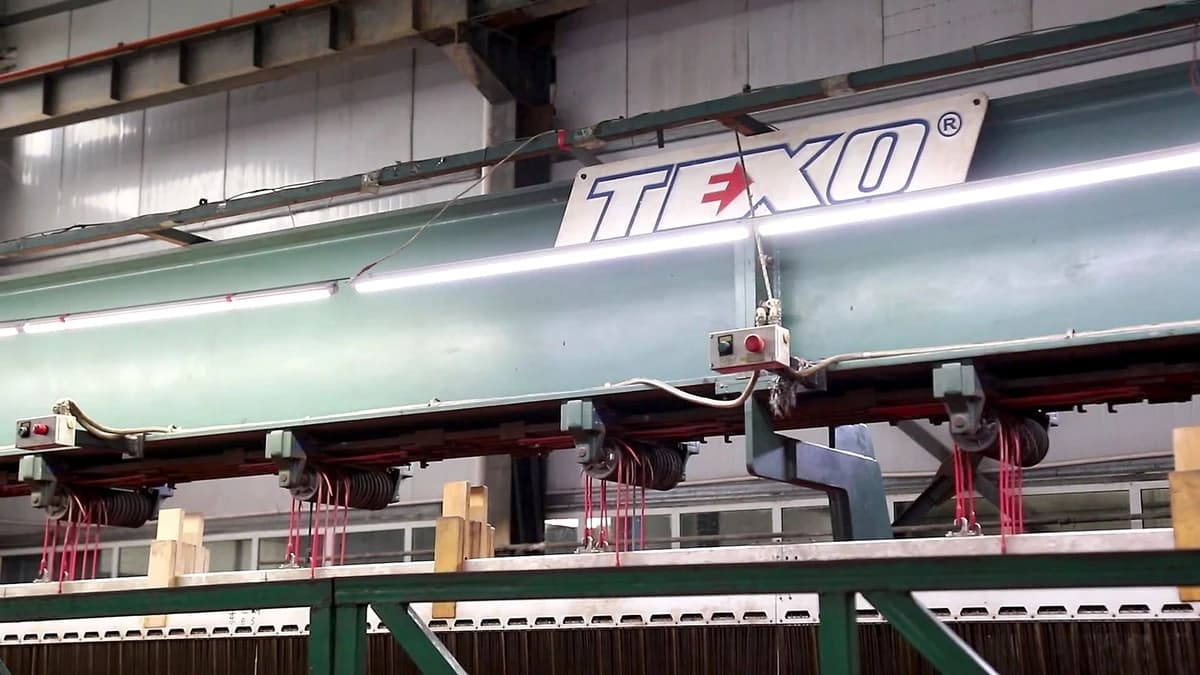
Why in-house extrusion matters
Fabric permeability, stability, wear volume and surface character all trace back to the yarn. A change in diameter or cross-section alters the weave geometry even when the weave pattern is unchanged. Producing the yarn on site lets us hold those variables to the agreed design and trace a finished fabric back to its material batch.
What is specified
Polymer grade, diameter and cross-section (round or flat), dimensional tolerance, shrinkage behaviour under heat setting, colour or additive requirements and the surface finish are agreed as a set. Where hydrolysis resistance or higher temperature exposure is required, the polymer choice is reviewed against the actual operating window rather than described in general terms.
Supply and traceability
Yarn is supplied against a fabric design or an agreed manufacturing requirement, with batch identification and the test method used to verify diameter and tensile behaviour. The diameter and property tables on this page are industry-common reference values transcribed from public supplier pages, with their sources and unit caveats shown; they are not Hengfeng measurements. We do not publish a fixed Hengfeng yarn model catalogue, because a diameter without its tolerance and test condition is not a usable specification.
Configurable dimensions
- Polymer grade and any hydrolysis-resistant or high-temperature requirement
- Diameter and dimensional tolerance
- Cross-section: round or flat, with aspect ratio where applicable
- Shrinkage behaviour under the agreed heat-setting conditions
- Colour, additive or anti-static requirement
- Surface finish and winding / package format
- Batch traceability and test method for diameter and tensile behaviour
Information to send for a specification
Tell us the end fabric design or manufacturing requirement; unknown items may be left blank.
- End use: fabric design, manufacturing or repair
- Required diameter range and tolerance
- Cross-section and aspect ratio
- Polymer requirements and operating temperature / chemical exposure
- Heat-setting conditions the yarn must withstand
- Package format, quantity and delivery requirements
- Test methods you require for incoming inspection
Industry reference specifications (public sources) — not Hengfeng measurements
These are publicly published, industry-common reference values transcribed from third-party supplier and competitor pages on 9 November 2026, with the source and test conditions shown beside each table. They are NOT Hengfeng test results, NOT a Hengfeng product specification, and NOT a performance or supply commitment. They exist so that a technical discussion can start from comparable terms. Final values are confirmed in a written specification against your machine conditions.
PET monofilament diameter / linear density reference
A monofilament is ordered by diameter, linear density, breaking force, elongation, shrinkage and tolerance. This table reproduces one published diameter series verbatim.
| Diameter (mm) | Linear density (D, as published) | Breaking force (≥ N) | Elongation at break (≤ %) | Heat shrinkage (≤ %) | Density (g/cm³) |
|---|---|---|---|---|---|
| 0.08 | 70 | 1.5 | 20 | 5 | 1.38 |
| 0.10 | 110 | 2.5 | 20 | 5 | 1.38 |
| 0.12 | 160 | 3.5 | 20 | 5 | 1.38 |
| 0.15 | 250 | 5 | 20 | 5 | 1.38 |
| 0.20 | 440 | 9 | 20 | 5 | 1.38 |
| 0.25 | 680 | 13 | 20 | 5 | 1.38 |
| 0.30 | 980 | 19 | 20 | 5 | 1.38 |
| 0.40 | 1740 | 32 | 20 | 5 | 1.38 |
| 0.50 | 2720 | 50 | 20 | 5 | 1.38 |
| 0.60 | 3920 | 70 | 20 | 5 | 1.38 |
| 0.80 | 6960 | 120 | 20 | 5 | 1.38 |
| 1.00 | 10880 | 180 | 20 | 5 | 1.38 |
Test conditions & comparability
The source states ≤20% elongation and ≤5% heat shrinkage as uniform maxima for the whole series, without a test temperature or duration. It does not publish a diameter tolerance per row.
- PAPTEX lists a 0.08–1.0 mm diameter range for its polyester monofilament product line; another supplier publishes a broader 0.045–1.00 mm range.
- Linear density is published here in denier (D); other suppliers use dtex. The two units are not interchangeable and no conversion is applied.
Public sources
- PET monofilament diameter / denier table
- PAPTEX (paptexpmc.com)Model sheets explicitly state that values are transcribed from reviewed technical parameter sheets and require machine-condition confirmation.
Accessed: 2026-11-09
Published PET monofilament property windows
For a quotation, the usable specification is a property window plus its test method — not a single diameter. These published windows show how wide the common ranges are.
| Property | Published range | Condition / unit note |
|---|---|---|
| Diameter | 0.045–1.00 mm | NTEC published range; PAPTEX product line: 0.08–1.0 mm |
| Linear density | 20–10850 dtex | dtex, not denier |
| Elongation at break | 15–45% | As published; no test method stated on this page |
| Strength at break | 3.7–5.3 cN/dtex | As published; not the same as breaking force in N |
| Dry heat shrinkage | 0.5–20% | At 180 °C, as published |
| Boiling water shrinkage | 1–8% | As published |
Test conditions & comparability
These are catalogue windows from a single supplier page, not acceptance limits. Diameter tolerance, polymer grade, hydrolysis resistance, colour and test method must be agreed in a written specification.
Public sources
- NTEC PET monofilament property ranges
- PAPTEX (paptexpmc.com)Model sheets explicitly state that values are transcribed from reviewed technical parameter sheets and require machine-condition confirmation.
Accessed: 2026-11-09
Air-permeability values are comparable only when the unit, differential pressure and test method match. The tables above come from different sources, some without a stated test condition, and cannot be used as acceptance criteria or a performance promise. Binding values are those in the mutually confirmed written specification.
Frequently asked questions
Is the monofilament made by Hengfeng or purchased?
Hengfeng operates in-house monofilament extrusion. It is the starting material for our own forming fabrics, dryer fabrics and industrial belts.
Do you publish a diameter catalogue?
We do not publish a fixed Hengfeng yarn model catalogue. The diameter table below is an industry-common reference from a public supplier page, with its source and unit caveat shown; it is not a Hengfeng measurement. Diameter, tolerance and test method are agreed in a written specification tied to the fabric design.
Can flat and round cross-sections be supplied?
Both are produced for our own fabric constructions. Availability for external supply is confirmed against the agreed fabric design and production plan.
Hengfeng manufactures this family in-house. The parameter tables on this page are publicly published, industry-common reference values transcribed from third-party supplier and competitor pages, with each source and test condition shown next to the table. They are NOT Hengfeng measurements, NOT a Hengfeng product specification and NOT a performance or supply commitment. Model designations, permeability, dimensions and seam details are configured against your machine conditions and become binding only in a written specification. Request a configuration review for that specification.
Request a monofilament specification
Share the fabric design or manufacturing requirement for a written yarn specification.
Send an enquiry